Chasing Light and History: My Olympus Lens Adventure
Walking through the ancient stones of Olympia, I wasn’t just visiting a ruin—I was stepping into a living photo studio shaped by time, light, and legend. The way the morning sun hits the Temple of Zeus, or how shadows stretch across the stadium at golden hour, turns every click of the shutter into a story. If you’ve ever wanted to capture more than just a picture—if you want to frame feeling—this place will rewrite your understanding of travel photography. Olympia is not merely a destination; it’s a dialogue between past and present, illuminated by the softest and most dramatic natural light. For photographers, especially those drawn to history and atmosphere, it offers a rare chance to create images that breathe with meaning.
Why Olympia? The Allure of Myth and Moment
Olympia, nestled in the lush valley of the Alfeios River in the western Peloponnese, stands apart from other archaeological sites not only for its historical significance but for its profound visual resonance. As the birthplace of the Olympic Games in 776 BCE, it carries a legacy that transcends sport—it embodies human aspiration, unity, and the enduring pursuit of excellence. For a photographer, this depth of meaning translates into emotional weight behind every frame. The site is not frozen in time but alive with echoes: the whisper of runners on ancient tracks, the glow of sacred flame rituals, the quiet reverence of visitors pausing before weathered columns. These intangible elements are what elevate a photograph from documentation to storytelling.
The physical landscape of Olympia enhances this atmosphere. Unlike stark, isolated ruins, the sanctuary unfolds amid olive groves, plane trees, and rippling water, creating a harmony between nature and architecture. Sunlight filters through leaves onto marble fragments, casting dappled patterns that shift with the hour. The textures are rich and varied—crumbling limestone, smooth river stones, bronze-green olive leaves—all offering contrast and depth. The Temple of Hera, with its surviving columns standing like sentinels, provides a powerful subject, while the foundations of the Temple of Zeus suggest grandeur through absence. Photographing here becomes an exercise in layering: light, texture, history, and emotion intertwine.
One of the most moving aspects of Olympia is its continuity. Every four years, the Olympic flame is still lit at the Temple of Hera using a parabolic mirror and the sun’s rays—a ritual that links modern ceremonies to ancient tradition. Capturing this moment, or even the altar where it occurs, allows a photographer to document a living thread of history. It’s not just about photographing stone; it’s about conveying the persistence of spirit. When visitors, especially women of all ages, stand before these ruins, there’s often a quiet recognition—a sense of connection to something larger than oneself. That emotional resonance is what makes Olympia not just photogenic, but profoundly meaningful.
Best Times to Shoot: Mastering Light and Crowd Flow
Success in photographing Olympia begins with timing. The quality of light changes dramatically throughout the day, and so does the presence of visitors. To capture the site in its most intimate and visually compelling form, early mornings are unparalleled. Between 6:30 and 8:30 a.m., especially in spring and early autumn, the sun rises gently over the eastern hills, casting a soft, golden glow across the ruins. This is the ideal window for achieving warm highlights and long, expressive shadows. The air is still, the colors are rich, and the site is often nearly empty. For photographers seeking solitude and pristine light, dawn is non-negotiable.
Midday light, while harsher, has its own advantages. When the sun is high, contrasts sharpen, revealing intricate details in the stonework—the chisel marks on ancient capitals, the texture of weathered steps, the geometry of column drums. This is the best time for architectural photography, where clarity and precision matter. Using a polarizing filter can reduce glare on marble surfaces and deepen the blue of the sky, adding drama without overprocessing. While the crowds tend to peak between 11 a.m. and 3 p.m., strategic movement through the site allows for candid shots of visitors engaging with history—children touching inscriptions, elders pausing for reflection—without cluttering the frame.
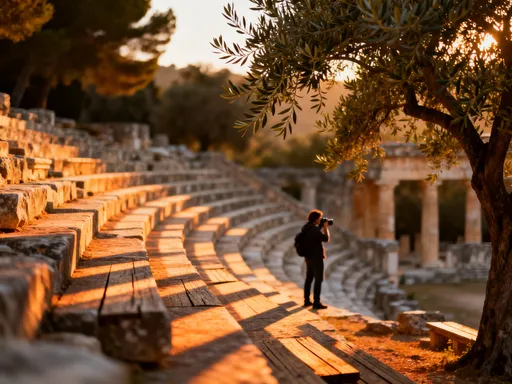
Golden hour in the late afternoon, beginning about an hour before sunset, offers a second wave of magical light. The sun, now low in the west, bathes the stadium and museum in a warm, honeyed tone. Shadows stretch across the track, echoing the strides of ancient athletes. This is a prime time for silhouette shots, especially along the stadium’s starting line or against the backdrop of the Pelopion. Additionally, the light filtering through the olive groves creates a dreamlike effect, perfect for portraits or mood-driven compositions. By planning visits around these light cycles and avoiding peak tourist hours—often tied to cruise ship arrivals or guided group tours—photographers can maintain a calm, focused presence and return with images that feel authentic and undisturbed.
Key Spots Every Photographer Must Frame
Certain locations within the archaeological site of Olympia offer unmatched photographic potential. The ruins of the Temple of Hera, one of the oldest Doric temples in Greece, are essential. With six of its original columns still standing, it provides a strong vertical element amidst horizontal ruins. Shooting from a low angle at dawn emphasizes its stature against the sky, while a wide-angle lens captures its relationship to the surrounding sanctuary. The sacred olive tree nearby, said to be a descendant of those used for victors’ wreaths, adds a living connection to the past and a natural focal point for detail shots.
The ancient Olympic stadium, where athletes once competed in the nude for honor and glory, is another must-capture site. Though only the earthen track and embankments remain, the sense of scale is powerful. A wide shot from the center of the track, looking toward the starting gates, conveys the length and simplicity of the original venue. Including a single visitor walking along the edge can emphasize both the vastness and the timelessness of the space. The starting line, with its stone blocks and grooves for athletes’ toes, is a detail-rich subject—ideal for macro photography or close-ups that tell a story of preparation and anticipation.
Inside the Archaeological Museum of Olympia, the statue of Hermes by Praxiteles awaits. This masterpiece of classical sculpture, believed to be the only original work by a renowned ancient sculptor, is bathed in controlled lighting that enhances its marble perfection. Photographing it requires respect and subtlety—flash is prohibited, so high-ISO settings and steady hands are necessary. Capturing the curve of Hermes’ arm, the softness of the infant Dionysus’ cheek, or the play of light on polished stone allows for intimate, emotionally resonant images. The museum also houses bronze figurines, pottery, and inscriptions—each offering a chance to document history in miniature.
For panoramic views, the hill of Kronos offers a sweeping vista of the entire sanctuary, framed by cypress and olive trees. From this vantage point, the layout of Olympia becomes clear—the alignment of temples, the flow of pathways, the embrace of nature. A telephoto lens can isolate specific structures, while a wide shot captures the site as a living landscape. This perspective helps photographers—and viewers—understand Olympia not as scattered ruins but as a cohesive, sacred complex designed in harmony with its environment.
Gear Tips That Won’t Weigh You Down
Photographing Olympia does not require a heavy kit. In fact, mobility enhances creativity. A lightweight mirrorless camera with interchangeable lenses offers excellent image quality without burden. A 24-70mm f/2.8 lens serves as a versatile workhorse for most scenes, from wide architectural shots to tighter details. For expansive views of the sanctuary or dramatic skies, a wide-angle lens like a 16-35mm is invaluable. A prime lens, such as a 50mm f/1.8, excels in low light and delivers stunning sharpness for portraits or sculpture details—ideal for the museum’s interior.
A compact travel tripod is highly recommended, especially for early morning or late afternoon shots when shutter speeds slow. It enables long exposures for silky water effects along the Alfeios River or crisp night shots of the illuminated ruins during special events. Look for carbon fiber models that balance stability and portability. A polarizing filter remains one of the most useful accessories, reducing reflections on stone and water while enhancing sky contrast. Neutral density filters can also be helpful for daytime long exposures, such as smoothing motion in flowing water or blurring moving visitors to create a sense of solitude.
For those traveling light or relying on smartphones, modern devices offer remarkable capabilities. Using the native camera app in Pro mode allows manual control over ISO, shutter speed, and focus. Third-party apps can enable RAW shooting, preserving more data for editing. A small clip-on lens—such as a wide-angle or macro attachment—can expand creative options. Stabilization is key; resting the phone on a bench, rock, or even a folded scarf can prevent blur. Natural light remains the greatest ally; positioning oneself with the sun at an angle rather than directly behind or in front ensures balanced exposure and rich textures.
The philosophy behind gear selection should be intentionality. Every additional item adds weight and decision fatigue. By traveling with only what serves a clear purpose, photographers remain agile and present—able to respond to fleeting moments of light or unexpected compositions. Simplicity fosters mindfulness, and mindfulness leads to more meaningful images.
Composing the Past: Techniques for Story-Driven Shots
Great photography at Olympia is not about capturing everything, but about selecting moments that convey meaning. Composition is the language of this storytelling. Leading lines—such as the rows of columns in the Temple of Hera or the parallel grooves of the stadium starting blocks—guide the viewer’s eye into the image and emphasize depth. Using the rule of thirds, place key elements like a solitary column or a walking visitor off-center to create balance and intrigue. Symmetry, abundant in ancient Greek architecture, can be highlighted by centering a subject, such as the reflection of a column in a puddle after rain.
Look beyond the grand vistas. Details tell powerful stories: a cracked inscription half-buried in soil, a single olive leaf resting on a marble step, the handprint worn into a stone threshold by centuries of touch. These micro-moments connect the viewer to the human experience of the past. A macro lens or smartphone close-up mode can reveal textures invisible to the naked eye—the grain of weathered stone, the patina on bronze—inviting intimacy and contemplation.
Natural framing—using archways, tree branches, or broken walls to encircle a subject—adds layers of depth and focus. For example, shooting the Temple of Zeus through the branches of an olive tree softens the background and ties nature to antiquity. Including human elements, even unintentionally, can convey scale and continuity. A woman in a sunhat pausing before the altar of Zeus, a child running across the stadium—these fleeting moments remind us that history is not distant, but lived. Avoid staging; authenticity emerges from observation, not direction.
Black and white photography can be especially effective at Olympia, stripping away color to emphasize form, light, and shadow. It lends a timeless quality to images, aligning with the ancient setting. Converting a color photo in post-processing allows for selective control over tonal contrast, bringing out the drama of stone against sky. However, color should not be dismissed—spring’s green foliage against golden stone, or the deep blue of a cloudless sky over white columns, creates vibrant, emotionally uplifting compositions.
Beyond the Ruins: Hidden Vistas and Natural Beauty
While the archaeological site is the heart of Olympia, the surrounding landscape holds its own photographic treasures. The Alfeios River, flowing gently beside the sanctuary, offers serene riverside paths lined with reeds, willows, and wildflowers. Early morning mist rising from the water creates ethereal scenes, perfect for soft-focus or long-exposure techniques. Reflections of trees and ruins in still pools double the visual impact, offering symmetrical compositions that feel both natural and poetic.
Just outside the main site, quiet groves of olive trees stretch across the hillsides. These ancient trees, some hundreds of years old, have gnarled trunks and silvery leaves that shimmer in the breeze. Photographing them at golden hour, with backlit foliage glowing like stained glass, evokes a sense of timelessness. The contrast between the organic curves of the trees and the geometric precision of nearby ruins creates a visual dialogue between nature and human creation.
Local viewpoints, known to residents but often missed by tourists, provide framed panoramas of the sanctuary. One such spot, a small rise near the modern village of Archaia Olympia, looks down on the temple ruins with the Kronos hill in the background. Arriving at dawn, when the site is bathed in soft light and often wrapped in a light fog, can yield images that feel almost mystical. These hidden vantage points allow photographers to capture Olympia not as a crowded destination, but as a sacred, living landscape.
The nearby village itself, with its traditional stone houses and flowering bougainvillea, offers cultural context. A café with a view of the hills, a local artisan selling olive oil, or a quiet church with a bell tower—these scenes ground the journey in the present, showing how modern life coexists with ancient heritage. Including such elements in a photo essay adds narrative richness and emotional depth.
From Capture to Memory: Editing with Respect
Post-processing is not about altering reality, but about honoring what was seen and felt. The goal is to enhance, not invent. Begin with subtle adjustments: correct white balance to reflect the true warmth of morning or afternoon light, increase contrast slightly to bring out texture in stone, and use clarity sparingly to define edges without creating harshness. Cropping should refine composition, removing distractions while preserving the integrity of the scene.
Avoid over-saturation, excessive sharpening, or dramatic filters that distort the natural palette. Olympia’s beauty lies in its authenticity; editing should reflect that. For black and white conversions, use luminance sliders to control how different colors translate into gray tones—brightening blues for open skies, darkening greens for dramatic foliage. Selective dodging and burning can guide the viewer’s eye, highlighting a column’s edge or softening a bright patch of sky.
Respect for the subject extends to metadata and captions. When sharing images, include accurate location names, historical context, and the time of day. This transforms a photo from a mere image into an educational and emotional artifact. For family photographers—especially women who may share these images with children or grandchildren—this practice preserves not just beauty, but meaning.
Editing is also a moment of reflection. As you review your shots, ask: Does this image convey the feeling I had when I pressed the shutter? Does it honor the place? If the answer is yes, then the photograph has succeeded. It is no longer just a record, but a tribute.
When a Photo Becomes a Pilgrimage
Photographing Olympia is more than a technical exercise—it is an act of connection. It invites the photographer to slow down, to observe deeply, and to listen to the whispers of history carried on the wind. The click of the shutter is not just a mechanical sound; it is a moment of recognition, a way of saying, I was here, and I felt this. For women who travel with intention—for those who seek beauty, meaning, and personal renewal—Olympia offers a rare convergence of light, legacy, and stillness.
The images we bring home are not merely souvenirs. They are invitations—to remember, to reflect, to share. They carry the warmth of the Greek sun, the texture of ancient stone, the quiet pride of a flame rekindled across millennia. In a world that often feels rushed and fragmented, such photographs ground us. They remind us that some things endure: the pursuit of excellence, the beauty of nature, the power of place.
So pack your camera, but leave room for wonder. Visit Olympia not to capture the perfect shot, but to be changed by the experience. Let the light guide your lens, and let the past speak through your frame. When you return, your photos will not just show where you’ve been—they will reveal who you’ve become. And in that transformation, the journey finds its truest purpose.