Walls That Whisper: Getting Lost in Genoa’s Architectural Soul
Walking through Genoa feels like flipping through the pages of a living history book, where every alleyway murmurs stories of maritime glory and artistic reinvention. The city’s architecture isn’t just stone and paint—it’s layered with centuries of culture, resilience, and unexpected beauty. From towering Renaissance palaces to narrow medieval caruggi, Genoa pulls you into an immersive journey where design and destiny intertwine. This is more than sightseeing—it’s feeling the pulse of a city through its buildings.
First Impressions: Stepping Into a Vertical City
Genoa greets visitors with a dramatic embrace of sea and stone. Unlike flat, orderly cities that unfold in predictable grids, Genoa climbs steep hills, its buildings stacked like shelves along the Ligurian coast. This vertical arrangement is no accident—it’s the result of centuries of urban adaptation to rugged terrain and a bustling port economy. As you step off the ferry or train, the city rises before you, a cascade of ochre, terracotta, and weathered gray stone climbing skyward. The urban fabric is dense, almost compressive, yet full of rhythm and surprise. Narrow streets snake uphill, flanked by tall structures that lean slightly, as if whispering secrets across the alley.
The city’s topography has shaped its architectural identity. With limited flat land, Genoese builders maximized vertical space, constructing homes and palaces that soar five or six stories high. These buildings were designed not only for efficiency but also for comfort—narrow streets provide shade in summer and shelter from the wind in winter. The result is an intimate streetscape where sunlight filters in at odd angles and shadows shift like clockwork throughout the day. Even the skyline tells a story: church domes punctuate the horizon, their silhouettes softened by time and salt air, while the occasional bell chime echoes between buildings like a call to presence.
As you begin your walk from the Old Port toward the historic center, the atmosphere changes subtly but unmistakably. The sounds of cruise ships and waterfront cafes give way to the hush of enclosed streets, where footsteps echo and voices carry farther than expected. This transition marks the boundary between modern convenience and ancient rhythm. The buildings here are not monuments behind glass—they are lived-in, worn, and deeply connected to daily life. Shopkeepers sweep their thresholds, neighbors call out from windows, and the scent of fresh basil and baking bread drifts from open doorways. Genoa does not perform its history; it lives it, one stone step at a time.
The Caruggi: A Maze of Medieval Memory
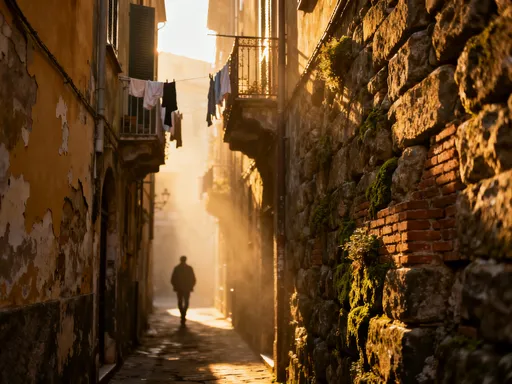
At the heart of Genoa’s old town lies the labyrinth of caruggi—tight, winding alleys that twist like ancient veins beneath centuries-old buildings. These narrow passageways, some barely wide enough for two people to pass, were originally designed for defense and climate control. In medieval times, their confusing layout made it difficult for invaders to navigate, while the overhanging upper floors provided shade and protection from the elements. Today, walking through the caruggi is both a physical and emotional experience—one of disorientation, intimacy, and quiet revelation.
Each turn reveals a new architectural fragment: a Gothic arch half-buried in a modern storefront, a Baroque doorway with chipped stucco, a Roman foundation repurposed into a wine cellar. The walls, often damp and moss-covered, bear the marks of time in peeling paint, iron grilles, and centuries-old inscriptions. Sunlight spills in brief shafts, illuminating laundry strung between balconies or a stray cat darting into a shadowed alcove. There are no grand vistas here—only close-up details that reward slow observation. A carved stone cherub, a faded fresco behind glass, a wrought-iron balcony with intricate scrollwork—these are the quiet treasures of the caruggi.
What makes this network so compelling is not just its age but its continuity. Unlike reconstructed historic districts in other cities, Genoa’s caruggi have never been fully sanitized or commercialized. They remain residential, home to families, artisans, and small businesses. A grandmother might water her geraniums in a fifth-floor window, while a young artist sells handmade prints from a ground-floor studio. This authenticity gives the area its soul. Visitors are not merely observers but temporary participants in a living urban rhythm. To get lost in the caruggi is not a mistake—it is the best way to understand Genoa on its own terms.
Palazzi dei Rolli: Power on Display
A short climb from the harbor leads to the grand Palazzi dei Rolli, a collection of noble residences that once housed Genoa’s most powerful families. These mansions, built during the city’s 16th- and 17th-century golden age, are masterpieces of Renaissance architecture with distinct local character. Unlike the austere palaces of Florence or the flamboyant villas of Venice, Genoese palazzi balance elegance with practicality—symmetrical facades, arched windows, sculpted portals, and interior courtyards that blend light and privacy. Their significance goes beyond beauty: they were part of an official state system known as the Rolli, a unique practice in European history.
When foreign dignitaries, ambassadors, or royalty visited Genoa, the government would assign them lodging based on rank, selecting a palace from a public list—the rolli. This lottery system ensured that the city’s wealth was shared in diplomacy, turning private homes into instruments of statecraft. The palazzi were not just symbols of personal success but active participants in Genoa’s political and economic influence. Today, many of these buildings are open to the public, offering a rare glimpse into the opulence of the past. Palazzo Rosso, Palazzo Bianco, and Palazzo Doria Tursi—now part of the city’s museum network—showcase grand staircases, frescoed ceilings, and period furnishings that reflect centuries of artistic patronage.
Walking through these spaces, one senses the calculated grandeur of a republic built on trade and negotiation. The interiors are designed to impress: vaulted halls with gilded moldings, painted skies on ceilings, and marble floors that echo with every step. Yet there is also a sense of restraint—no excess for its own sake, but architecture as a language of power, taste, and civic pride. The Palazzi dei Rolli were inscribed as a UNESCO World Heritage site in 2006, not only for their architectural value but for their role in shaping urban hospitality as a political tool. For modern visitors, they offer more than aesthetic pleasure—they provide insight into how space, wealth, and diplomacy once intertwined in this maritime republic.
Baroque Flourishes and Religious Grandeur
Genoa’s churches elevate spiritual expression through architecture, transforming faith into sensory experience. The Basilica della Santissima Annunziata del Vastato stands as a prime example—a modest exterior gives way to an overwhelming Baroque interior where every surface seems alive with color, movement, and gold. Statues burst from walls, angels soar from cornices, and the ceiling opens into a painted heavenscape filled with swirling clouds and divine figures. This is not decoration for beauty’s sake; it is theology made visible, designed to inspire awe, devotion, and a sense of the sacred.
Baroque architecture in Genoa served a purpose beyond ornament. In an era of religious competition and Counter-Reformation fervor, the Catholic Church used dramatic interiors to reaffirm faith and draw people back to worship. The effect is immediate and powerful: entering such a space feels like stepping into another world, one where the divine is not distant but present, almost tangible. The play of light through stained glass, the scent of incense, the soft echo of footsteps on marble—all contribute to an atmosphere of reverence. Other churches, like San Matteo or Santa Maria di Carignano, display similar intensity, blending sculpture, painting, and architecture into a unified emotional experience.
Yet not all sacred spaces in Genoa embrace such extravagance. The Cathedral of San Lorenzo offers a different kind of power—one rooted in centuries of continuity. Its facade combines Romanesque solidity with Gothic elements, including a striking black-and-white striped pattern and a single, slender tower. Inside, the atmosphere is more restrained, though no less meaningful. The cathedral has stood as a spiritual center since the 12th century, surviving fires, wars, and reconstructions. Its survival is a testament to resilience, and its architecture reflects a layered history—Romanesque arches meet Renaissance chapels, and a rare Hebrew scroll is preserved in its archives, a quiet nod to Genoa’s long-standing Jewish community. The contrast between exterior modesty and interior richness defines much of Genoa’s religious architecture: faith expressed not through size alone, but through depth, memory, and artistry.
Maritime Influences: Where Sea Meets Structure
As a historic port city, Genoa’s architecture bears the unmistakable mark of the sea. The Mediterranean is not just a neighbor—it is a co-architect, shaping materials, forms, and daily life. Salt winds, humidity, and coastal storms have influenced building choices for centuries. Local stone, such as Pietra di Lavagna, is favored for its durability and resistance to erosion. Shutters are common, not just for privacy but to protect interiors from sudden downpours and sea spray. Roofs are often sloped to shed rain, and foundations are reinforced to withstand shifting ground near the water.
The Old Port, once a working harbor cluttered with cranes and cargo, has been transformed into a vibrant public space while retaining its maritime soul. Redesigned by Genoese architect Renzo Piano in the 1990s, the area balances heritage and innovation. Glass-covered pavilions float above the water, housing an aquarium, exhibition spaces, and a ferry terminal. The transparent structures reflect the sky and sea, creating a dialogue between architecture and environment. Piano’s design respects the scale and rhythm of the old city while introducing modern clarity and lightness. The result is a waterfront that feels both contemporary and timeless.
Further east, the fishing village of Boccadasse offers a quieter expression of maritime architecture. Its colorful houses, painted in soft blues, pinks, and yellows, cluster around a small cove, their sloped roofs and shuttered windows adapted to coastal life. Fishermen once lived and worked here, mending nets and launching boats at dawn. Today, the area is a beloved retreat for locals and visitors alike, where the pace slows and the sound of waves replaces traffic. The preservation of Boccadasse’s character—resisting over-commercialization—demonstrates Genoa’s ability to honor its past without freezing it in time. The sea, ever present, continues to shape how the city builds, lives, and dreams.
Hidden Courtyards and Secret Gardens: Urban Oases
Beyond the bustling streets and towering facades, Genoa hides tranquil pockets of green and silence—inner courtyards and secret gardens that serve as urban oases. Tucked behind unmarked doors or accessible through narrow passageways, these spaces were once private retreats for noble families, offering respite from the density of city life. Today, many remain hidden, revealed only to those who know where to look or during special cultural events like Genova Oltre le Mura, when private gardens open to the public for a few days each year.
These courtyards vary in style and scale. Some are grand, with symmetrical staircases, fountains, and citrus trees in terracotta pots. Others are humble—simple stone squares with a single well, ivy climbing the walls, and the soft drip of water from an old spout. The Orto Botanico dell’Università di Genova, though not hidden, embodies the spirit of these green sanctuaries. Nestled on a hillside, it features climbing jasmine, ancient magnolias, and shaded benches where visitors can sit in quiet contemplation. The air here is cooler, scented with herbs and damp earth, a world away from the noise below.
What unites these spaces is their purpose: to provide peace, privacy, and connection to nature within an intensely urban environment. In a city where space is precious and every square meter is accounted for, these oases reflect a deep cultural value—the need for stillness amid motion. They also reveal another layer of Genoese architecture: one that prioritizes inner experience over outward display. A magnificent facade may impress, but a quiet courtyard restores. For the traveler, discovering one of these hidden gardens is like being let in on a secret—a reminder that beauty often lies behind closed doors, waiting to be found by those who walk slowly and look closely.
Modern Touches and Adaptive Reuse
Genoa does not live in the past. While its historic core remains intact, the city has embraced thoughtful modernization through adaptive reuse and contemporary design. This spirit of renewal ensures that Genoa evolves without erasing its identity. Abandoned warehouses along the port have been transformed into art galleries, cultural centers, and creative workspaces. The Mercato Orientale, once a bustling food market, now hosts exhibitions and performances while retaining its original iron-and-glass structure. These projects honor the past not by freezing it, but by allowing it to serve new purposes.
Renzo Piano, one of Genoa’s most celebrated sons, has played a key role in this transformation. His designs—including the Biosphere, a glass and steel geodesic dome that houses a tropical garden, and the modern ferry terminal—demonstrate how innovation can coexist with heritage. Piano’s work is marked by lightness, transparency, and respect for context. He does not impose; he listens. His interventions enhance rather than dominate, using materials and forms that echo the city’s maritime character—glass that reflects water, steel that recalls shipbuilding, open spaces that invite the sea breeze.
Street art also contributes to Genoa’s evolving identity. Murals appear on once-blank walls, blending contemporary expression with ancient stone. These artworks, often community-driven, add color and narrative to neglected corners, turning alleys into open-air galleries. Unlike cities where graffiti is seen as vandalism, Genoa has embraced it as part of its urban dialogue. The result is a dynamic architectural fabric where every layer—from medieval foundations to modern interventions—adds depth and meaning. There is no conflict between old and new; instead, there is conversation, continuity, and care.
Conclusion: Architecture as Living Memory
Genoa’s buildings do more than stand—they speak. They tell of trade empires, artistic movements, and daily life shaped by terrain and tide. To walk its streets is to experience architecture not as static backdrop, but as active participant in the city’s story. The caruggi whisper of medieval resilience, the palazzi echo with diplomatic grandeur, and the churches soar with spiritual ambition. Even the sea, the shutters, the hidden courtyards—all are part of a language built in stone, paint, and memory.
For travelers seeking depth over spectacle, Genoa offers a rare gift: the chance to feel history, not just see it. This is not a city of curated highlights or Instagram-perfect vistas, but one of texture, contrast, and quiet revelation. Its beauty is not immediate; it unfolds slowly, in the curve of a staircase, the pattern of a tile, the way light falls on a mossy wall at dusk. To get lost here is not to be disoriented—it is to be invited in.
Genoa reminds us that architecture is not just about design, but about life. It is shaped by people, weather, economy, and belief. It adapts, survives, and tells stories long after their makers are gone. In a world of fast travel and fleeting impressions, Genoa asks us to slow down, to touch the walls, to listen to what they whisper. For those willing to walk its streets with attention and heart, the city offers more than a journey through space—it offers a journey through time, one stone step at a time.