Oxford’s Best-Kept Photo Spots: Where Every Frame Feels Like a Postcard
You know that feeling when you stumble upon a place so picture-perfect it takes your breath away? Oxford isn’t just about ancient libraries and studious students—its streets, courtyards, and rivers hide some of the most stunning, under-the-radar spots perfect for capturing moments that look straight out of a dream. I’ve walked every cobblestone path, and trust me, this city is a visual masterpiece waiting to be photographed. With its harmonious blend of medieval architecture, tranquil green spaces, and timeless waterways, Oxford offers endless opportunities for authentic, emotionally resonant photography. It’s not just about ticking off landmarks—it’s about finding stillness in symmetry, poetry in shadows, and beauty in the quiet corners no guidebook mentions.
The Visual Magic of Oxford
Oxford is more than a global symbol of academic excellence; it is a city sculpted by centuries of artistry, where every alleyway, spire, and garden feels like a carefully composed painting. The stone façades glow under morning light, the ivy drapes like natural lace, and the rhythm of daily life unfolds with a quiet grace that invites observation. In recent years, travelers have increasingly sought destinations that offer not only history and culture but also visual richness—places where every turn offers a new frame worthy of preservation. Oxford delivers this in abundance. What sets it apart is its ability to balance grandeur with intimacy. While the world knows its libraries and lecture halls, fewer realize how deeply poetic the city feels when seen through a lens. This is not about staged perfection but about capturing the soul of a place—where light dances on centuries-old stone, and silence speaks louder than crowds.
Photographing Oxford becomes an act of storytelling. Each image can convey a sense of timelessness, a whisper of centuries past, or the fleeting beauty of a misty dawn. Unlike cities that rely on modern spectacle, Oxford’s charm lies in subtlety—the curve of an archway, the texture of weathered brick, the way sunlight filters through autumn leaves onto a cobbled path. These are not just backdrops; they are characters in a living narrative. For the mindful traveler, the city rewards patience and presence. The best shots are rarely found in the busiest moments but in the stillness between them—when the world slows, and the camera sees what the eye often overlooks.
The Timeless Allure of the Radcliffe Camera and Bodleian Library
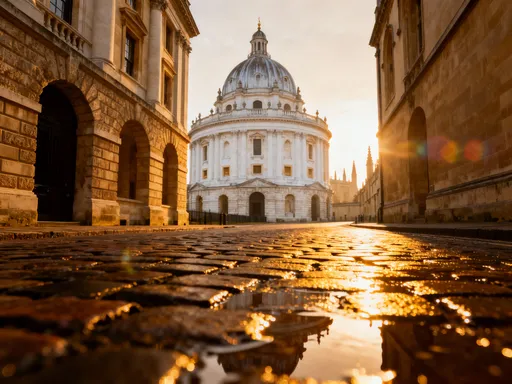
No image says “Oxford” quite like the Radcliffe Camera, standing proudly at the heart of the city like a symmetrical jewel set within a ring of ancient colleges. This 18th-century circular library, part of the Bodleian complex, is not only an architectural marvel but one of the most photographed subjects in England. Its domed roof, Corinthian columns, and harmonious proportions create a natural focal point for any composition. Yet, to truly capture its essence, one must go beyond the standard postcard angle. The secret lies in timing and perspective. Early morning, before the tour groups arrive, transforms Broad Street into a quiet stage where light falls gently across the stone, casting long shadows and soft highlights that enhance depth and texture.
One of the most powerful vantage points is from the west end of Catte Street, where the full façade of the Bodleian Library frames the Radcliffe Camera like a portrait within a portrait. When rain has just passed, the wet cobblestones act as a natural mirror, doubling the grandeur and creating a dreamlike reflection that elevates the scene into something almost surreal. Shooting during golden hour—especially in late spring or early autumn—adds a warm glow that brings the pale stone to life. The interplay of light and shadow across the columns and pediments reveals details invisible under harsh midday sun. For those using wide-angle lenses, careful framing can include passersby in traditional academic dress, adding a human element that grounds the image in Oxford’s living culture.
What makes this location enduring is not just its beauty but its symbolic weight. Every photograph taken here connects the viewer to centuries of scholarship, discovery, and quiet contemplation. It’s a reminder that architecture can inspire awe not through scale alone but through proportion, balance, and history. While it may be one of the city’s most famous sights, approaching it with intention—waiting for the right light, choosing an unexpected angle, or capturing a fleeting moment of stillness—can transform a familiar view into something deeply personal and original.
Christ Church Meadow: Nature Meets Grandeur
Just beyond the stone walls of Christ Church College lies one of Oxford’s most serene and visually rich landscapes—Christ Church Meadow. This expansive green space, crisscrossed by footpaths and bordered by the River Cherwell, offers a rare fusion of cultivated beauty and wild nature. In the early hours, when mist rises from the grass and the spires of nearby colleges emerge like silhouettes from a dream, the meadow becomes a photographer’s paradise. The combination of open sky, reflective water, and architectural elegance creates a painterly atmosphere that changes with every season and every hour of daylight.
Spring brings soft green shoots and the delicate blossoms of cherry and apple trees, while summer fills the fields with wildflowers and buzzing insects, adding texture and life to wide-angle shots. Autumn transforms the meadow into a canvas of gold and crimson, with leaves drifting onto the water and the warm hues of the college buildings glowing in the low sun. But perhaps the most magical time is dawn in any season, when the air is still and the only movement comes from swans gliding silently across the river or a heron stepping cautiously through the reeds. These quiet moments invite long-exposure photography, where the flow of water becomes a smooth, glassy surface, and the world seems to pause.
One of the most iconic compositions involves the Hinksey Stream bridge, where the stone arch frames a perfect view of Tom Tower in the distance. Using a telephoto lens from the far side of the meadow can compress the perspective, making the tower appear to rise directly from the water. Alternatively, a low-angle shot from the riverbank, with a swan in the foreground and the mist wrapping around the trees, creates a sense of depth and tranquility. Because this area is less crowded than central Oxford, photographers can take their time, adjusting tripods and experimenting with focus and aperture to achieve the desired mood. It’s a place where patience is rewarded—not just with great images, but with a deep sense of peace.
The Hidden Charm of the University Parks
For those seeking a more intimate and less trodden green space, the University Parks offer a beautifully curated escape just a short walk from the city center. Spanning over 70 acres, these parks are a haven of floral displays, shaded groves, and meandering pathways that change dramatically with the seasons. Unlike the formal symmetry of college quads, the University Parks embrace a more natural aesthetic—where trees grow at gentle angles, flowers spill freely from borders, and ducks paddle lazily in ornamental ponds. This organic beauty makes it ideal for photography that feels personal and unposed.
In late May and June, the rose garden bursts into color, with hundreds of blooms in shades of pink, crimson, and ivory. Backlighting during early morning or late afternoon can make the petals appear almost translucent, adding a soft, glowing quality to close-up shots. The use of a macro lens reveals the delicate veins of each flower, while a shallow depth of field blurs the background into a dreamy haze. Nearby, the herbaceous borders offer rich textures and layered compositions, especially when framed against the backdrop of tall trees or a clear blue sky.
Autumn brings its own magic, as the maple and beech trees turn fiery red and golden yellow. The long, straight path leading toward the northeastern boundary becomes a tunnel of color, perfect for perspective shots that draw the eye into the distance. Reflections in the still ponds—especially after a light rain—double the impact of the foliage, creating symmetrical compositions that feel both balanced and dynamic. Weeping willows along the water’s edge provide natural framing devices, their drooping branches forming soft arches that guide the viewer’s gaze toward the center of the image. Because the parks are popular with locals, they also offer candid moments—children feeding ducks, couples strolling hand-in-hand, or students reading beneath the trees—all of which can be captured with discretion and respect.
Port Meadow: Wild Beauty Just Minutes from Town
Just a fifteen-minute walk from Carfax Tower, Port Meadow feels worlds away from the polished elegance of central Oxford. This vast, open landscape—protected as common land since the 12th century—is one of the city’s best-kept secrets. Stretching along the northern bank of the River Thames (locally known as the Isis), it offers sweeping views, grazing horses, and a sense of untouched freedom rarely found so close to an urban center. For photographers, it’s a place of raw, elemental beauty—a reminder that Oxford is not just about stone and scholarship, but also about sky, water, and earth.
Sunset here is nothing short of cinematic. As the sun dips below the horizon, the sky ignites in shades of orange, pink, and purple, casting a warm glow across the wetlands and silhouetting the ponies that roam freely across the meadow. A low-angle shot with a wide lens can capture the animals in silhouette, their forms stark against the luminous sky, while a longer exposure smooths the rippling water into a mirror-like surface. The old stone bridge near the southern end—known as Grandpont—adds a historic touch, its weathered arches framing the river and distant hills.
Early morning brings a different kind of magic. Mist often lingers over the grass, wrapping the meadow in a soft, ethereal haze. Birdsong echoes across the fields, and the first light filters through the fog, creating beams that feel almost divine. This is the perfect time for minimalist compositions—single trees rising from the mist, lone ponies in the distance, or the quiet curve of the river winding through the landscape. Because Port Meadow is largely undeveloped, there are no modern intrusions to break the spell. No streetlights, no signage, no buildings—just nature and history in quiet conversation. It’s a rare place where time seems to stand still, and every photograph feels like a meditation.
Courtyards and Cloisters: Secret Corners of Oxford’s Colleges
While many visitors flock to the grand facades of Oxford’s colleges, the true photographic treasures often lie within—the quiet courtyards, ivy-covered walls, and cloistered walkways that define the inner life of these ancient institutions. Merton College, founded in 1264, boasts one of the oldest and most atmospheric quads, where lichen-speckled stone and arched doorways create a sense of timeless enclosure. New College, despite its name, dates back to 1379 and features a stunning cloister wrapped in ivy, where light filters through Gothic tracery in delicate patterns. Magdalen College, with its lush garden quad and towering tower, offers both grandeur and intimacy in a single frame.
Photographing these spaces requires sensitivity and awareness. While many colleges welcome visitors, especially during certain hours and seasons, they remain places of study and reflection. The best approach is to move quietly, avoid blocking pathways, and refrain from using flash or tripods in crowded areas. Early arrival—just after opening time—ensures fewer people and softer light. In Merton’s Mob Quad, for example, shooting from the southwest corner at mid-morning allows sunlight to graze the eastern wall, emphasizing texture and depth. The worn steps, ancient doorways, and weathered wood all tell stories that go beyond aesthetics.
One of the most compelling aspects of college photography is the contrast between stillness and life. A perfectly symmetrical courtyard may be interrupted by a student hurrying across with a book under their arm—a fleeting moment that adds narrative depth. Capturing such scenes requires anticipation and a readiness to adapt. A telephoto lens can isolate details—the engraving on a stone plaque, the handle of an old door, the pattern of light on a tiled floor—while a wide-angle lens can encompass the entire quad, emphasizing scale and order. These spaces are not museums; they are living environments where history and modernity coexist. The photographs we take become records of that harmony.
Along the Thames and Cherwell: Boathouses, Bridges, and Golden Light
The rivers that flow through Oxford—the Thames and the Cherwell—are not just scenic backdrops but central characters in the city’s visual story. Lined with willow trees, wooden boathouses, and stone bridges, these waterways offer some of the most romantic and reflective photography opportunities in the region. At dawn, when the air is cool and the surface of the water is glassy, the city’s architecture doubles in the river, creating symmetrical compositions that feel almost otherworldly. The punts—long, flat-bottomed boats used for leisure—add a traditional touch, their wooden frames and striped awnings evoking a bygone era.
Magdalen Bridge, with its solid stone arches and commanding view of the college tower, is a favorite subject, especially in the early hours when foot traffic is minimal. From the eastern side, a wide-angle shot can capture the curve of the river, the bridge in the foreground, and the tower rising in the distance, all mirrored in the water. Further upstream, the Cherwell winds through quieter stretches, where overhanging trees create natural tunnels of green. In spring, the banks burst with bluebells and daffodils; in summer, the lush foliage forms a dense canopy; in autumn, the reflections of red and gold leaves shimmer with every ripple.
For those willing to explore on foot, the towpaths offer uninterrupted access to hidden corners. A lightweight mirrorless camera or even a high-quality smartphone allows for easy movement along the uneven terrain. Polarizing filters can reduce glare and enhance the clarity of underwater reflections, while neutral density filters enable longer exposures, turning flowing water into a soft, misty veil. Because river conditions change with weather and season, revisiting the same spot at different times can yield dramatically different results. One day, the water may be choppy and gray; the next, calm and golden. This unpredictability is part of the joy—each visit offers a new possibility.
Mastering the Light: Timing, Seasons, and Local Tips
In photography, light is everything—and in Oxford, it is both a gift and a challenge. The city’s stone buildings respond dramatically to changes in illumination, revealing textures at dawn that disappear under midday sun. To capture Oxford at its best, timing is essential. Early mornings, particularly between 5:30 and 7:30 a.m., offer the most favorable conditions: soft, directional light, minimal crowds, and a quiet atmosphere that enhances both focus and creativity. Overcast days, often dismissed by casual photographers, are ideal for even lighting and rich color saturation, especially in green spaces like the University Parks or Port Meadow.
The golden hours—shortly after sunrise and before sunset—are prime times for architectural and riverside photography. During these windows, the low angle of the sun creates long shadows, warm highlights, and a sense of depth that flat light cannot replicate. Blue hour, the period just before sunrise or after sunset, transforms the city into a moody, atmospheric scene, perfect for long-exposure shots of illuminated spires and glowing windows. For planning, apps like PhotoPills or Sun Seeker can help predict sun position, twilight duration, and shadow direction with remarkable accuracy.
Seasonally, May and June offer long days, blooming gardens, and soft light, while September provides clear skies, golden tones, and fewer tourists. Winter, though colder, brings its own rewards—frost-covered stone, bare branches framing buildings, and a unique stillness during holiday breaks. Regardless of season, preparation is key. Dress in layers, bring a small tripod for stability, and always carry a lens cloth—Oxford’s damp air can fog lenses quickly. Above all, respect the environment: avoid stepping on grass in college quads, keep noise to a minimum near academic buildings, and remember that students are preparing for exams even as you seek the perfect shot.
Oxford Through the Lens—More Than Just a Snapshot
Photographing Oxford is more than a technical exercise—it is an invitation to slow down, to observe, and to connect. Each image becomes a personal record of discovery, a moment of stillness captured in a world that often moves too fast. The city does not reveal itself all at once; it unfolds gradually, through repeated visits, changing light, and quiet attention. The most meaningful photographs are not always the most dramatic but the ones that carry feeling—the way mist curls around a spire, how a single leaf floats on still water, or the quiet dignity of an empty courtyard at dawn.
As travelers, we often seek beauty in grand gestures, but Oxford teaches us to find it in detail, in balance, in the harmony between nature and architecture, past and present. When we raise our cameras, we are not just recording what we see—we are interpreting what we feel. And in that act, we become part of the city’s ongoing story. So take your time. Walk without haste. Let the light guide you, and let the city surprise you. Because in Oxford, every corner holds a new frame, and every frame can become a memory that lasts a lifetime.